Highlights of the Festival:
Meeting so many lovely people and great poets.
Hearing so many great readings: Imtiaz Dharker, Carol Ann Duffy, Gillian Clark, Caroline Carver and Katrina Naomi among my favourites.
Meeting Michael Swan, author of Practical English in Use, every ESL teacher's bible!
Drinking Long Island iced tea and smoking cigarettes for the first time in 7 years.
Selling/giving away all copies of my home-made pamphlet (sorry about the typos).
Reading poems in front of an audience for the first time.
Having the National Poet of Wales say nice things about my reading.
Having anybody say nice things about my reading.
Wonderful! See you next year.
giovedì 4 ottobre 2012

domenica 28 novembre 2010
By way of explanation of the last post: the next stage of my journey to the dark side of trained teacherdom, as opposed to the blissful kingdom of "a bit of a chat for an hour and a half and some decent money", is DELTA module 2, where you take part in an identity parade of one and your classroom crimes and misdemeanours are pored over by People Who Are Much Better At This Than You ( that emphasis is real, not sarcasm). Part of this unenviable process is a teaching diary, which it will be your pleasure to read here whenever I update it.
For the uninitiated, in Cambridge there are no such things as students, only learners, or "Ls" to save time in the exam. L1 means your language, L2 means anyone else's. You could probably have figured that out yourselves, but I just can't help myself.
If you're one of my students, sorry, learners, don't worry - I wasn't talking about you.
About three weeks ago I decided to start recording my students telling stories. The reactions ranged from horror to outright refusal (they changed their minds after everyone else did it), but the interesting thing was that afterwards, when we analysed the recordings, they were all extremely positive about the whole process. I used two basic approaches.
1. I had found a radio programme where a woman talked about her first experience in the 1980s with the 'new generation' of Marks and Sparks sandwiches, talking about how they seemed extraordinary at the time. I decided to record my students talking about their first experiences of food or, failing that, an anecdote or powerful memory related to food. I gave them some time to prepare it (with use of dictionaries, without writing anything). We analysed the extract from the radio programme for typical features of storytelling and spoken discourse and then tried to apply some of these things to improve what we heard on the recording. We also went through the recordings looking for other improvements that weren't necessarily exemplified in the radio programme. Basically we deconstructed and reconstructed their stories as a group.
2. For lower levels, simple analysis of the story without reference to L1 model. I usually tended toward analysis of hesitation with these Ls.
Some of the typical problems that arose, even at higher levels, were:
a) no pronoun substitution and therefore unnatural repetition
b) unnatural hesitation
c) failure to 'close' the story so that the listener didn't know if the speaker was finished or not
d) failure to provide proper emphasis and intonation for key moments of the story
e) lack of 'vague' language
I decided not to ask them to retell the story after the analysis as I thought they would be too self-conscious and fluency would suffer. I don't know if that was the right decision.
I'm obsessed with hesitation at the moment. When we heard a particularly long and distracting 'errrr' in the recordings (and there were a great many), I asked them to tell me why. If their answers are to be believed, there are three main causes of unnatural hesitation:
1. They don't know the word and have to paraphrase
2. They do know the word but it's not immediately accessible
3. There are two or more words competing for use
The first problem is fairly easily remedied. The second shouldn't have been an issue since I asked them to tell themselves the story mentally in English before recording it. My guess is that very few people actually did this. On the other hand, in the heat of the moment, we tend to want to improvise, or something comes to mind that we hadn't thought of before ( as E.M. Forster once said, "How do I know what I think until I see what I say?"). For many of them it may have been the first time they had told that story in any language. Maybe the next time I do this the only specification will be that it has to be a story they've told many times already.
Intonation and emphasis at key moments in the story came up only towards the final recordings and I realised only then how crucial it is to successful communication. Unfortunately, it also seems as if it's the most difficult thing to master. I really don't know how we can teach it without ending up with speakers who sound like bad actors. Intonation is a kind of emotional fingerprint and therefore is something that can only be absorbed where there is a 'whole person' relation, i.e. face to face contact with a great many different L1 speakers. Or maybe not. Then there is always the question of just how much a learner is willing to change to sound authentic.
I think particularly with storytelling, teachers find themselves dealing with issues that are not strictly connected to L2 competence. Some people are naturally better at it than others and some may be entirely incapable of coherent longer turns even in L1. Perhaps this makes a lesson of this kind doubly valuable for Ls - they get two skills for the price of one. On the other hand, perhaps the general strain of having to really think about what you say before you say it makes your overall production in L2 a little better in some respects.
Another problem was the unnatural setting. Recording yourself is stressful, but I told them that this simpy mimicked the pressure of speaking in L2 to people you don't know very well. The cause of stress in both cases is fear of judgement (it also occurred to me that it seems a little ironic that many people like talking but no-one wants to listen to themselves as they do it). The setting also made the listeners understandably reluctant to interrupt or ask for clarification or take part in some collaborative work with the speaker, something that is completely natural and essential in L1 storytelling, especially in 'rounding off' a story. The next time I do this, I think I'll try and make it a little more natural by inviting the other students to be a little more interactive.
I should say again now just how much the Ls liked this activity. There was usually always a feeling of "Wow, it's not actually that bad!" We all had a lot of fun.
lunedì 26 aprile 2010
Snooker. I can't get enough of it. They make it look so easy - I used to play for twenty minutes without ever getting a ball anywhere near a pocket. Positional play? Let's not be silly.
It's causality at its most fundamental or rather, the kind of causality most easily grasped by humans - you hit something, it hits something else which hits something else. You move, stuff happens. It's physics explained to children. And yet the variety of it, the jaw-dropping skill, the almost superhuman perception of angles and space all turn it into a long, soothing meditation on the relationship between mind and matter, creative intelligence and ironclad determinism. In many respects it resembles chess, but where chess favours pure intelligence, snooker gets to grips with the physicality of things. The chess player is a tyrant over his pieces; the snooker player is constantly negotiating with his world, never fully in control, always trying to make up for an inch too long here, an inch too short there.
venerdì 5 febbraio 2010
It's snowing and bells are ringing in the church across from the school...a pack of hunting dogs chasing down a deer and I'll know that the border between this world and the other world has thinned almost to nothing.
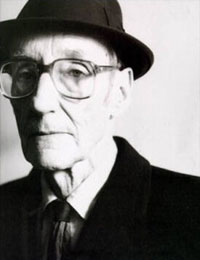
Imagine my suprise on opening the New Yorker to discover that someone had written a poem about meeting William Burroughs in a dream, in a farmhouse - exactly what I dreamt a short time after he died. I'll have to write a response. Burroughs himself wrote often of being in the land of the dead, where he would meet with friends and acquaintances who were dead or dying; his trilogy, 'Cities of the Red Night', 'The Place of Dead Roads' and 'The Western Lands' is a great epic of death, partly set in the afterlife. As in a great many dreams, Burroughs 'just knew' that it was the land of the dead, even before he met someone long gone. I saw, as well as Burroughs, my grandfather in that same place some time before he died, with his dog, who died a long time before that. The poet in the New Yorker says that Burroughs told him something - the dead in my dreams never say anything at all.
Considering it's the one absolutely inevitable fact of life, isn't it strange that very, very few people try to write about the moment of death? The only writer I know who ever tried was Beckett in 'Malone Dies' and perhaps also in 'The Unnameable', which might be read as the instant of death stretched out or dilated so that it seems unending. Now that I think about it, there is the Ambrose Bierce short story about a man being hanged - we think he has escaped but it is in fact his final fantasy as he drops. And another by someone whose name I can't remember fading out on a life support machine. So fair enough, there have been a few. But you'd think there would be more.
Anorther strange dream coincidence - one night (when else?), I dreamt that a fire began in a church and quickly spread to the rest of the city. I tried to take shelter in a doorway and the next thing I knew I was standing with my family in front of a lake. Two days later, I got an email from a girl I hadn't (and haven't) seen for years who said "I just dreamt about you - there was a fire but you escaped and you seemed very happy in front of a lake with your family." That's just the kind of thing you don't want to hear, isn't it? Our abiding connection is that we share a birthday - astrologers, do your worst.
I had to abandon Burroughs at a certain point - to say he's unhealthy would be an understatement. But perhaps I've been harsh on him. When I visited him, or when he visited me, he was the very soul of kindness.

giovedì 3 dicembre 2009
The Gathering Storm
So, here it is, weighing down and bulking up my rucksack, the latest monstrous installment of the monstrous fantasy cycle 'The Wheel of Time'. 'Eagerly awaited' does not even begin to describe it. This is book 12 and I've read all the others 3 times. This was supposed to be the last, but it's not just as simple as all that...
As literary tales go, this one is quite tragic. The author, Robert Jordan, began the books in the late 80s. He had wanted to write 12 about the journey towards the apocalypse in his fantasy world, undoubtedly the biggest and most painstakingly created I've ever come across. He finished 11, started 12 and died of a blood disease. Can you imagine? You would take it personally, wouldn't you? Not after 2, or 6, but 11. Just 1 to go. When I found out he was dead...
So when he knew he was dying, he told his wife the way he wanted it to go, wrote the final scene and then left it to another author to finish from his notes. But his notes, fully written up, were 3 books, not 1. So we have 3 final books waiting for us. This one, book 12, is the first of those.
So what's it like? By now, the characters and the cultures are so well-developed that the new author just has to pick up where Jordan left off. But the interesting thing is this - I had thought that Jordan didn't have much of a style: too many clichès, facile descriptions and excessive use of italics, to name but a few. Not personal, easily imitable. And yet this new writing is palpably inferior. On opening the book at random we have people 'cradled by blankets' and a character 'thick of neck and determined of attitude'. These are not happy sentences and Jordan would never have written them. The net result is that one feels a very definite nostalgia for a writer whose prose one never found particularly satisfying, which is a first in my reading experience.
With the best will in the world, and relatively simple as these characters are, it is clear now that they are 100% Jordan's and do not travel well. It is the confirmation of my feeling from the beginning with these books - that Jordan's love for his world animated the lifeless prose like a fish moving in stagnant water. It seems that passion, vision and earnestness in writing can occasionally substitute style; and these three things are so personal as to be inimitable, even when their expression is imperfect. I could mention Harry Potter here, another book where I had to willfully ignore the writing itself while acknowledging and enjoying the (occasional) genius of the characters and plot.
But am I going to stop reading it now? Absolutely not. After 11, would you?
As literary tales go, this one is quite tragic. The author, Robert Jordan, began the books in the late 80s. He had wanted to write 12 about the journey towards the apocalypse in his fantasy world, undoubtedly the biggest and most painstakingly created I've ever come across. He finished 11, started 12 and died of a blood disease. Can you imagine? You would take it personally, wouldn't you? Not after 2, or 6, but 11. Just 1 to go. When I found out he was dead...
So when he knew he was dying, he told his wife the way he wanted it to go, wrote the final scene and then left it to another author to finish from his notes. But his notes, fully written up, were 3 books, not 1. So we have 3 final books waiting for us. This one, book 12, is the first of those.
So what's it like? By now, the characters and the cultures are so well-developed that the new author just has to pick up where Jordan left off. But the interesting thing is this - I had thought that Jordan didn't have much of a style: too many clichès, facile descriptions and excessive use of italics, to name but a few. Not personal, easily imitable. And yet this new writing is palpably inferior. On opening the book at random we have people 'cradled by blankets' and a character 'thick of neck and determined of attitude'. These are not happy sentences and Jordan would never have written them. The net result is that one feels a very definite nostalgia for a writer whose prose one never found particularly satisfying, which is a first in my reading experience.
With the best will in the world, and relatively simple as these characters are, it is clear now that they are 100% Jordan's and do not travel well. It is the confirmation of my feeling from the beginning with these books - that Jordan's love for his world animated the lifeless prose like a fish moving in stagnant water. It seems that passion, vision and earnestness in writing can occasionally substitute style; and these three things are so personal as to be inimitable, even when their expression is imperfect. I could mention Harry Potter here, another book where I had to willfully ignore the writing itself while acknowledging and enjoying the (occasional) genius of the characters and plot.
But am I going to stop reading it now? Absolutely not. After 11, would you?
martedì 17 novembre 2009
I had the chance today to revisit some old ideas about language and mind, specifically the 'substance' of thought. The two main channels for thinking, as far as I can see, tend to be words and pictures - these can be manipulated, rearranged, broken down and put together in novel ways. They permit hypothetical imagination and reasoning and free us from the here and now. My question has always been this - sights are perceived by eyes, sounds by ears and smells by noses - and thoughts? What is the correct verb for a thought? I hear a thought? I see a thought? Most of my thinking takes the form of an aural hallucination, the ghost of speech. How does this come about? How does the trace of speech live on without employing the vocal apparatus or the ears? Is there a single part of the brain that deals with the auditory system? If it were damaged or removed, would we still be able to think in words? Or am I barking up the wrong tree altogether? Some theorists, such as Daniel Dennett, have described the phenomena of 'private' consciousness as a 'user illusion'. That may well be, the experience of thought is as real as any other and sometimes more so:
...wound in mind's wandering
as mummies in the mummy-cloth are wound.
WB Yeats, All Souls' Night
or
O imaginativa, che ne rube
talvolta sì di fuor ch'om non s'accorge
perchè dintorno suonin mille tube,
chi move te, se 'l senso non ti porge?
Oh imagination, that steals us from the world
so totally that the cacophony of a thousand organs
is as naught, who moves you when nothing moves the senses?
Dante, Purgatorio, canto 17
...wound in mind's wandering
as mummies in the mummy-cloth are wound.
WB Yeats, All Souls' Night
or
O imaginativa, che ne rube
talvolta sì di fuor ch'om non s'accorge
perchè dintorno suonin mille tube,
chi move te, se 'l senso non ti porge?
Oh imagination, that steals us from the world
so totally that the cacophony of a thousand organs
is as naught, who moves you when nothing moves the senses?
Dante, Purgatorio, canto 17
lunedì 16 novembre 2009
Last night I saw an extraordinary guitarist called Julian Lage playing with Gary Burton, Scott Colley and Antonio Sanchez at the Blue Note. I had seen him before about 6 years ago but either he was much better this time or I've learned to appreciate him more. His solos were lyrical and complete, his phrasing was exceptional and his sound was pure and penetrating, even in the acoustic mud of the Blue Note. He comes across as some kind of otherworldly, elfin creature who seems to be taking a borderline erotic pleasure in the music, but at the same time he projects a kind of boyish innocence an unself-consciuosness that stops it being uncomfortable. A great player.
The other stand-out was Scott Colley, a killer player I first heard with Tony Williams and then on the great record by Bojan Z., 'Transpacifik'. Huge sound and groove, patient and honest soloing. Antonio Sanchez, who played a monstrous set with Pat Metheny and Christian McBride a few years ago here in Milan, was in cruise control for most of this one since with three harmonic instruments (piano, guitar, vibes), there wasn't much space to do anything else. Always worth watching though.
Teaching-wise, I'm getting rearranged again, this time by Stephen Krashen. He's a downright kind of theorist, like Michael Lewis, with very clear ideas about correct methodology and practice. Basically, he states again and again that explicit knowledge of rules during language learning is at best useless and at worse counterproductive. His approach to learning is to relax, go with the flow and immerse yourself in the language (or whatever subject) you're studying. My experience of learning Italian would seem to back this up. I've never studied a 'rule' - guidelines for correct usage, yes, but a rule, no. If you're surrounded by something all day, every day, and are also motivated, says Krashen, you can't not learn. Who knows. It might be true of language, but it's certainly not true of, say, playing a musical instrument.
The other stand-out was Scott Colley, a killer player I first heard with Tony Williams and then on the great record by Bojan Z., 'Transpacifik'. Huge sound and groove, patient and honest soloing. Antonio Sanchez, who played a monstrous set with Pat Metheny and Christian McBride a few years ago here in Milan, was in cruise control for most of this one since with three harmonic instruments (piano, guitar, vibes), there wasn't much space to do anything else. Always worth watching though.
Teaching-wise, I'm getting rearranged again, this time by Stephen Krashen. He's a downright kind of theorist, like Michael Lewis, with very clear ideas about correct methodology and practice. Basically, he states again and again that explicit knowledge of rules during language learning is at best useless and at worse counterproductive. His approach to learning is to relax, go with the flow and immerse yourself in the language (or whatever subject) you're studying. My experience of learning Italian would seem to back this up. I've never studied a 'rule' - guidelines for correct usage, yes, but a rule, no. If you're surrounded by something all day, every day, and are also motivated, says Krashen, you can't not learn. Who knows. It might be true of language, but it's certainly not true of, say, playing a musical instrument.
giovedì 12 novembre 2009
Once again, the Sommo Poeta hijacks my mind for a day. This time, first terzina of the 18th canto of Paradiso:
Già si godea solo del suo verbo
Quello specchio beato, ed io gustava
lo mio, temprando col dolce l'acerbo.
And so that divine mirror
savoured his words, and I mine,
tempering the bitter with the sweet.
The pilgrim has just been told by one of his ancestors in Heaven that long years of exile await him (the bitter), but that his account of this period, the Commedia itself, will provide 'vital nourishment' through the ages for those who read it. Dante clearly had no doubt about the scope and importance of what he was doing, and he was right, so fair dues.
Dante carries on the idea of knowledge and words as food, 'vital nourishment', in the fact that he 'tastes' this prophecy, gustava. The Italian for what the ancestor Cacciaguida is doing, gode(v)a, is literally 'enjoying' or 'taking pleasure in', but considering it's sandwiched between two eating metaphors, I always imagine him 'chewing on' his words with some satisfaction. This verse does a magnificent job of capturing the 'deep silence', perhaps of the moment one rearranges oneself in the light of new knowledge or a profound idea, and also of putting into contrast the pilgrim (uncompleted, an alloy rather than the pure element, implied in temprando) and the already-blessed spirit (whole, pure, solo). Although the mirror is Cacciaguida himself reflecting the Divine essence, he is also reflecting the pilgrim, who understands the whole of himself in the word and presence of his ancestor.
It was playing on my mind probably because the two subjects of word-eating and silence have come up often in one of my classes. We had talked about the book Firmin, about a mouse who learns to read by eating his way through a bookshop, and also extensively about silence - you can find musings on both at ascoltareilsilenzio.blogspot.com. And here in this verse of Dante's we seem to have the two things combined - as usual, he got there first.
It's very difficult to explain how Dante conjures 'deep silence' with these lines. Cacciaguida seems withdrawn, statuesque, self-sufficient, probably because he is satisfied with his speech and his speech alone, solo del suo verbo, originating as it does from God. The pilgrim, as we mentioned above, tastes his fate, a bitter pill to swallow...perhaps eating and silence go hand in hand because we have all been taught - don't speak with your mouth full!
martedì 10 novembre 2009
What have I learned today? That abandoned children in Rome were traditionally given the surname 'Proietto' and in Florence 'Degli Innocenti'. I already knew in Naples it was 'Esposito'.Why couldn't they just have simplified everything by calling all those sprogs 'Bastardo'? Perhaps they were working by the principle of nomen omen and didn't want to curse the poor wee things any further.
Nomen omen - Burke, from the French 'De Burgh', of the city, or perhaps Cityson, which reads like a urinary infection. 'Townson' is better. Or perhaps 'Citizen' is the right version. I like the movement from 'son' to 'zen'. So, Sean A. A. Citizen, like John Q. Citizen. Nobody and everybody. But with a name like that, I'm never going to get out of these wretched places and be closer to natural things. The life of the city lived in repetitions of fragments. Up until last year I worked all over the place, every day in a different area, a different street. Since March 2008 I've been mainly in the one place just outside Milan. It's the first time in my life I've worked in one place for that length of time. I'm practically full time now, by teaching standards, but not really a part of the company, just tra coloro che son sospesi, amongst those who hang between. Between Scotland and Italy, between Italian and English, between the city and the country.
More things learned today: that the patron saint day of St. Cyrus in a town somewhere in the region of Lecce is celebrated very similarly to our Guy Fawkes, with an effigy of the saint placed on top of an olive-branch bonfire, presumably because he was burned alive. That in some places in India they fill a corpse's mouth with water from the Ganges before burning the body. That nobody knows how digital and print media are going to coexist in the future. That more and more people are writing 'should of' instead of 'should have', Lord help us.
Reading McCourt's biography of James Joyce, which goes to great pains to show us he probably knew the names of the local prostitutes and equally great pains to say he never went to a brothel. Legal issues with the Joyce estate, methinks. He does quite a good job of painting the Babel of languages in Trieste at the time and how that influenced Finnegans Wake. It's considerably more easy-going than Ellman's (with correlated disadvantages). Has anyone actually read the Wake from beginning to end?
Why don't people wear more colours? When I go down into the metro station in the mornings it looks like a funeral. When I think about all the colours my daughter puts on everyday, and here's me and everyone else in a variety of browns and blacks, occasionally blues. I'm going to buy a fluorescent yellow hat and scarf for winter - I may get mistaken for someone directing traffic but at least I'll have banished the air of mourning in the morning.
lunedì 9 novembre 2009
Forse il modo più utile per capire come insegnare è di capire come si impara. Se fossi meno pigro, avrei tenuto un diario del mio progresso con l'italiano; non l'ho fatto e quindi mi tocca cercare di ricostruire il percorso, con un pizzicho del senno di poi.
Prima cosa - non ho mai avuto una 'lezione d'italiano'. Cosa vuol dire? Vuol dire che non mi sono mai seduto davanti ad uno che si chiama 'insegnante', e chi ha cercato di farmi imparare qualcosa. Non ho mai seguito una struttura. Non sono passato dal più facile al più difficile, tant'è che sbaglio ancora delle cose semplicissime. Ma nonostante tutto ciò, o forse proprio a causa di tutto ciò, riesco a comunicare, a farmi capire, nella maggior parti delle situazioni.
Aparte studenti ed amici, ho imparato tanto da:
Prima cosa - non ho mai avuto una 'lezione d'italiano'. Cosa vuol dire? Vuol dire che non mi sono mai seduto davanti ad uno che si chiama 'insegnante', e chi ha cercato di farmi imparare qualcosa. Non ho mai seguito una struttura. Non sono passato dal più facile al più difficile, tant'è che sbaglio ancora delle cose semplicissime. Ma nonostante tutto ciò, o forse proprio a causa di tutto ciò, riesco a comunicare, a farmi capire, nella maggior parti delle situazioni.
Sono sette anni che sono in Italia, e direi che sono capace di parlare e capire a sufficienza da tre. Avrei fatto più progressi in meno tempo con un insegnante ed una struttura? Difficile dire. Ho avuto, e ho, degli 'insegnanti' - ma comunichiamo su un livello umano, socievole, normale, ragioniamo delle cose che ci importano - si chiamano 'amici'. Di solito mi aiutano quando non ho le parole (anche se spesso devo chiedere, sono troppo educati per correggermi!). Quando dico qualcosa veramente incomprensibile, è abbastanza lampeggiante, e ci devo riprovare. Cioè la buon fine del mio atto comunicativo, manifestato in una risposta adatta, è quello che mi guida.
Ma c'è anche l'orgoglio, l'io. Voglio parlare bene, voglio un accento che non spaventa la gente, voglio dire esattamente quello che penso e voglio dirlo in italiano, non solo in inglese tradotto.
Mi sono esercitato anche pensando. Immaginavo una situazione dove mi verrebbe da dire qualcosa in particolare, e immaginavo come si direbbe in italiano. Cioè traducevo. Si dice spesso che 'si deve pensare in inglese' - ma perchè? Una frase non diventa meno sbagliata perchè se la pensa. Ma serve perchè così la lingua è sempre pronta ad entrare nella bocca, lo spazio tra cervello e lingua viene ridotta e l'interlocutore non si stufa di dover aspettare a sentirti balbettare.
Ormai le due lingue seguono le proprie strade. Con questo intendo dire che ci sono dei pensieri e frasi che sorgono spontaneamente sia in italiano che in inglese. E questo è il salto misterioso. A volte penso che sia una semplice questione di quantità, che si raggiunge ad una massa critica di input, vocaboli e frasi, che permette al cervello di produrre frasi nuovi e di ripetere bene quelli già sentiti. La repetizione è fondamentale. Sicuramente fallisco come insegnante per quanto riguarda la ripetizione - cerco sempre la novità, di mostrare agli studenti cose nuove. Dovrei andare più per circoli. Ma adesso che ci penso succede anche questo, che spesso ci ripetiamo...ma devo alzare la ripetizione fino ad un'arte!
Aparte studenti ed amici, ho imparato tanto da:
la pubblicità
graffiti
free press e giornali
origliare le conversazioni altrui
Dante, Manzoni, Pirandello e Sciascia
Cronisti di calcio
Vuoi raccontare la tua esperienza con una seconda lingua? Lascia un commento!
giovedì 5 novembre 2009
lunedì 2 novembre 2009
Ma quando gli dico/ch'egli è tra i fortunati che han visto l'aurora/sulle isole più belle della terra/al ricordo sorride e risponde che il sole/si levava che il giorno era vecchio per loro.
Which, pace Robert Frost's definition of poetry as 'that which is lost in translation', might be rendered as:
But when I tell him/that he is one of the lucky few who have seen the dawn/on the most beautiful islands on earth,/he smiles at the memory and answers that at the rising of the sun/the day, for them, was already old.
Cesare Pavese's description of a man who has spent many years travelling and returns home ends on this seemingly melancholy note. But what is expressed in the traveller's smile? It can be read as one of indulgence, the tempered, worldly-wise elder to the romantic youth, saying long may you live to believe it. And so there would be pity here as well, in the knowledge that experience will eventually destroy, without necessarily remaking, the younger man's notions of beauty and of its importance. The day was already old...they had been busy, they were too tired to take in whatever beauty might be in the dawn. Had the elder gone looking for this beauty and then forgotten about it in the daily grind, making the smile one of regret? Or had it never interested him in the first place, and now he is smiling at the memory of the work, the companionship amongst the crew which he has given up for this new life, for a wife he leaves at home? Perhaps it is a genuine smile at the remembered beauty and his gruff, worldly qualification, the day was already old, is an attempt to exorcise that memory, since the feeling of nostalgia, or of the beauty itself, is too intense and threatens to break through into this new life and destroy it.
domenica 1 novembre 2009
As if I didn't have enough of blethering in the classroom, I feel the need to blether here too. And all this shortly after attending a wonderful book launch about silence, "Il Paradosso del Silenzio" a collection of essays edited by Nicoletta Polla-Mattiot. I was used to philosophical/cultural meetings being a battleground of specialist against specialist, to the point where I was tempted to write a TV programme, "When Academics Attack"; so it was inspiring to see an intellectual gathering at the service of what is, or should be, a common experience - the various modes of silence.
I learnt that deafness associated with old age exists only in noisy places, unlike loss of sight, which is universal. I learnt about a village in Saudi Arabia whose main industry is to grow a special kind of rose from which they make perfume, 17 kilos a year, all of which is given exclusively to the king. I discovered that there is such a thing as a' metaphorologist' and she lives and teaches in Switzerland. But perhaps the most gratifying thing was, perhaps contrary to the will of the organisers, the explosion of conversation at the end, the desire everyone had simultaneously to join in, to share their experiences of silence. Some of these experiences can be found at www.ascoltareilsilenzio.org, for the Italian speakers amongst you. Any thoughts about silence in English can be left here!
Iscriviti a:
Post (Atom)
